
As the dust settles on the 78th World Health Assembly (#WHA78), one message rings loud and clear: the future of healthcare in Africa is community-based. At the heart of this transformation are the over 107,000 Community Health Promoters (CHPs) in Kenya and millions more across the continent who are bridging the gap between policy and people, prevention and cure, and data and decision-making.
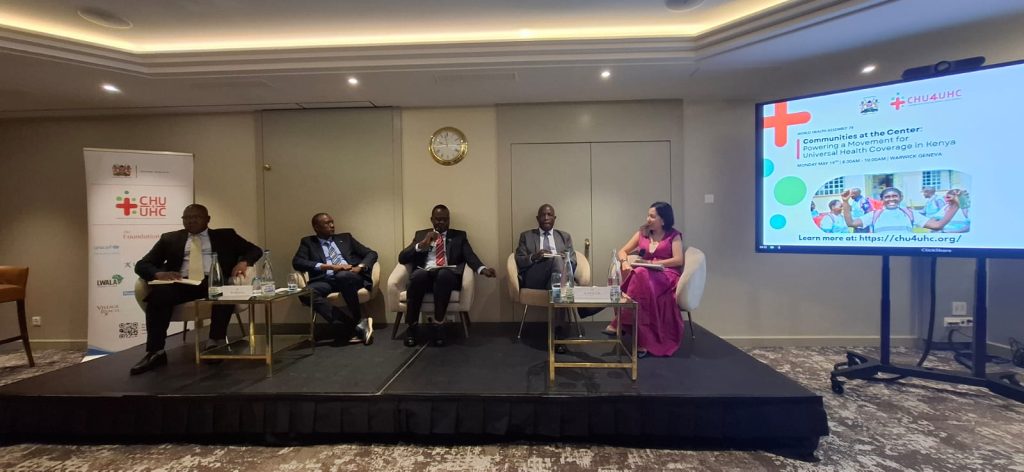
At a high-level session convened by the Community Health Units for Universal Health Coverage (CHU4UHC) Platform in partnership with the Ministry of Health, Kenya, leaders and frontline workers shared powerful stories and evidence of progress and made a collective call to keep the momentum alive.


Transforming Community Health in Kenya
Aloise Gikunda opened the CHU4UHC session with a powerful message: “With Ministry of Health leadership and catalytic support from the CHU4UHC Platform, we have transformed community health in Kenya.” Indeed, Kenya has professionalized 107,000 CHWs, ensuring they are digitally empowered, regularly remunerated, and equipped with essential job aids. This is no small feat; it represents a paradigm shift in how primary health care is delivered and experienced.
The Voices of Community Health Workers
Millicent Miruka, a Community Health Promoter (CHP) from Migori, shared her personal journey that underscores why this work is so critical. “I got married in a community that didn’t know the benefits of visiting a health facility. During my delivery, I had a postpartum hemorrhage in the hands of a Traditional Birth Attendant (TBA). I lost my child due to malnutrition. That’s why I decided to become a CHW,” she said.
Thanks to training, digital tools, and a monthly stipend, Millicent can now visit 8-10 households each day, offer health education, manage minor ailments, and ensure 100% skilled birth attendance and immunization coverage in her community.
Similarly, Saida, a Community Health Assistant (CHA) from Kakamega, described how she supervises 50 CHPs, supporting them with coaching, spot-checks, and on-the-job capacity building. “The digitization of CHWs has allocated tasks efficiently, and the stipends from the county and national governments are motivating,” she noted.
Policy Shifts and Systemic Change
Dr. Joseph Lenai traced the evolution of Kenya’s community health landscape. From the Alma-Ata Declaration to the recent Primary Health Care Act, Kenya has laid the legislative foundation for UHC. With over 14,000 Community Health Units serving 56 million Kenyans, the shift from curative to preventive care is paying off: 8.5 million households have been registered, 7 million people revisited, and 400,000 people referred for high blood pressure screening.
The Role of Partnerships: CHU4UHC in Action
Julius Mbeya, a founding member of CHU4UHC, highlighted how the COVID-19 pandemic catalyzed deeper collaboration among partners, building on inspiration from the Community Health Impact Coalition (CHIC). “CHU4UHC has helped deploy the national CHW curriculum, supported digitization, and facilitated the last-mile kitting and supervision of CHPs,” he explained.
John Wanyungu, Deputy Division of Community Health, emphasized how a government-led platform that brings all partners, big or small, under one plan has been crucial. “We need to ensure we don’t reverse the gains as we develop the regulations,” he cautioned.
The Global Perspective: Catalyzing Africa’s Community Health Workforce
James Guwani from the Africa CDC shared an ambitious continental target: 2 million professionalized CHWs by 2030. “The continent would not have made it this far without CHWs,” he affirmed, citing examples from Ethiopia’s integrated CHW program to Liberia’s financing innovations. He urged stakeholders to frame CHW investments in terms of ROI, linking health outcomes with economic gains and to engage Ministries of Finance as allies in this mission.
Alice Fabiano of the Johnson & Johnson Foundation echoed this, saying, “Good health starts with a well-supported human resource. We’re excited to see the professionalization of CHWs and are doubling down through our ‘care community’ initiative.”
Next Steps
As we look ahead, three key priorities stand out:
- Keep CHWs at the Centre: From policy to practice, ensure CHWs are recognized as the backbone of primary health care.
- Strengthen Measurement and Impact: Use data to demonstrate the value of CHWs and build the case for sustained investment.
- Catalyze Partnerships: Rally all stakeholders—government, partners, and communities around a unified, government-led plan.
At CHU4UHC, we are committed to ensuring that the momentum generated at WHA78 translates into long-term impact. We invite all partners, governments, and communities to join us in this journey because when CHWs thrive, communities thrive.